
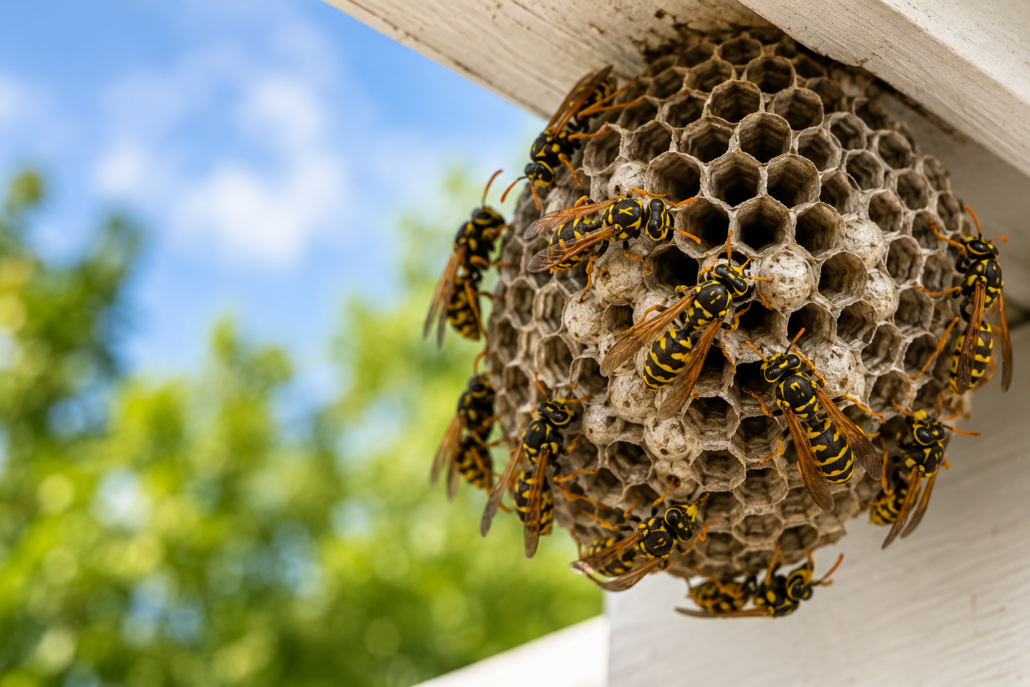
Why Wasps Get More Aggressive as Summer Goes On
Summer in New England means backyard cookouts, afternoons by the pool, and more time spent outdoors. Unfortunately, it also means wasps seem to be everywhere, especially as summer progresses.
If you’ve ever wondered why wasps appear relatively manageable in early summer but suddenly become much more noticeable and aggressive by August and September, there’s a reason. Their colonies, food sources, and behavior all change throughout the season.
Understanding what’s happening can help you recognize a growing wasp problem around your Rhode Island or Massachusetts property and know when it’s time to call in a professional.
Wasp Colonies Grow Throughout the Summer
One of the biggest reasons you notice more wasps later in the summer is simple: there are more of them.
Many social wasps begin their colonies in the spring. A queen emerges after surviving the winter and searches for a protected location to establish a nest. She initially does much of the work herself, laying eggs and caring for the first generation of workers.
Once those workers mature, the colony begins expanding rapidly. The workers take over jobs like gathering food, defending the nest, and caring for developing larvae while the queen focuses on reproduction.
By late summer, a nest that started with only a handful of wasps can contain a much larger population.
More wasps naturally means more activity around your home and a greater chance that you’ll cross paths with them.
Their Priorities Begin to Change
During the earlier part of the season, worker wasps spend much of their time hunting insects and gathering protein to feed developing larvae.
As summer winds down, the colony begins approaching the end of its natural life cycle. Fewer larvae may be available to feed, and worker wasps begin spending more time searching for food for themselves.
That’s when humans often start noticing them around sweet drinks, fruit, garbage cans, outdoor dining areas, and other sugary food sources.
That open soda can sitting on your patio suddenly becomes very interesting to a hungry wasp.
This change in feeding behavior is one reason wasps can seem particularly persistent during late-summer cookouts and outdoor events.
They Have More to Protect
A large, established colony has spent months growing its nest.
That means worker wasps have a significant investment to defend.
When someone gets too close to a nest, vibrations, movement, or other disturbances can trigger defensive behavior. Depending on the species and circumstances, multiple wasps may respond to a perceived threat.
This is why discovering a nest in August can be very different from spotting the beginnings of one in May.
The nest may now contain a substantial colony prepared to protect it.
Where Do Wasps Build Their Nests?
One of the challenges with wasps is that their nests aren’t always obvious.
You might see wasps flying around your property without immediately knowing where they’re coming from.
Common nesting areas around homes include:
- Rooflines and eaves
- Decks and porches
- Sheds and garages
- Wall voids
- Attics
- Trees and shrubs
- Outdoor structures
- Holes or cavities in the ground
If you repeatedly notice wasps traveling in and out of the same location, there may be a nest nearby.
Pay particular attention to activity around cracks, gaps, siding, soffits, and other openings in your home.
Why DIY Wasp Nest Removal Can Be Risky
Finding a wasp nest naturally leads to the question: Can I just remove it myself?
That can be risky, particularly with a large or difficult-to-access nest.
Wasps may become defensive when their nest is disturbed, and unlike honeybees, many wasp species are capable of stinging repeatedly.
Trying to knock down a nest, spray it from too close, block an active entrance, or disturb a hidden nest can result in multiple stings.
Hidden nests can be especially complicated. If wasps are entering through an opening in a building, the visible entrance may not tell you exactly where the colony is located.
Professional pest control technicians can identify the type of activity, locate the nesting area, and determine the appropriate treatment strategy.
How to Make Your Property Less Attractive to Wasps
You can’t completely eliminate wasps from the outdoors, but you can make your property less inviting.
Keep outdoor garbage containers tightly closed and clean up food and drink spills promptly. When eating outside, cover food when possible and avoid leaving sugary drinks unattended.
Regularly inspect your home’s exterior for gaps and openings that could provide nesting locations. Sheds, playsets, decks, porches, and other outdoor structures should also be checked periodically.
Most importantly, watch for patterns.
An occasional wasp flying through your yard isn’t necessarily cause for concern. But if you’re consistently seeing multiple wasps entering and exiting the same location, that’s worth investigating.
Don’t Wait Until a Small Wasp Problem Becomes a Big One
Wasp activity can increase dramatically as summer progresses. A nest that goes unnoticed early in the season may become a much bigger issue by late summer, right when you’re trying to enjoy your yard the most.
If you’ve noticed increased wasp activity around your home or business, don’t risk getting too close to the nest.
Lincoln Pest & Property Solutions can help identify the source of the activity and determine the best approach for your property.
Protect your family, customers, and outdoor spaces and get back to enjoying the rest of your summer without worrying about what’s buzzing nearby.
Seeing more wasps than usual? Contact Lincoln Pest & Property Solutions today to schedule an inspection or pest control service.
Lincoln Pest and Property Solutions is a locally owned and operated business serving Rhode Island & Southeastern Massachusetts. As one of the leading pest control companies in RI, our mission for over 35 years has been simple: Provide innovative and effective pest control solutions for your home or business, while maintaining a safe environment. We use the latest in eco-friendly technology to keep your home or place of business safe and pest free.


